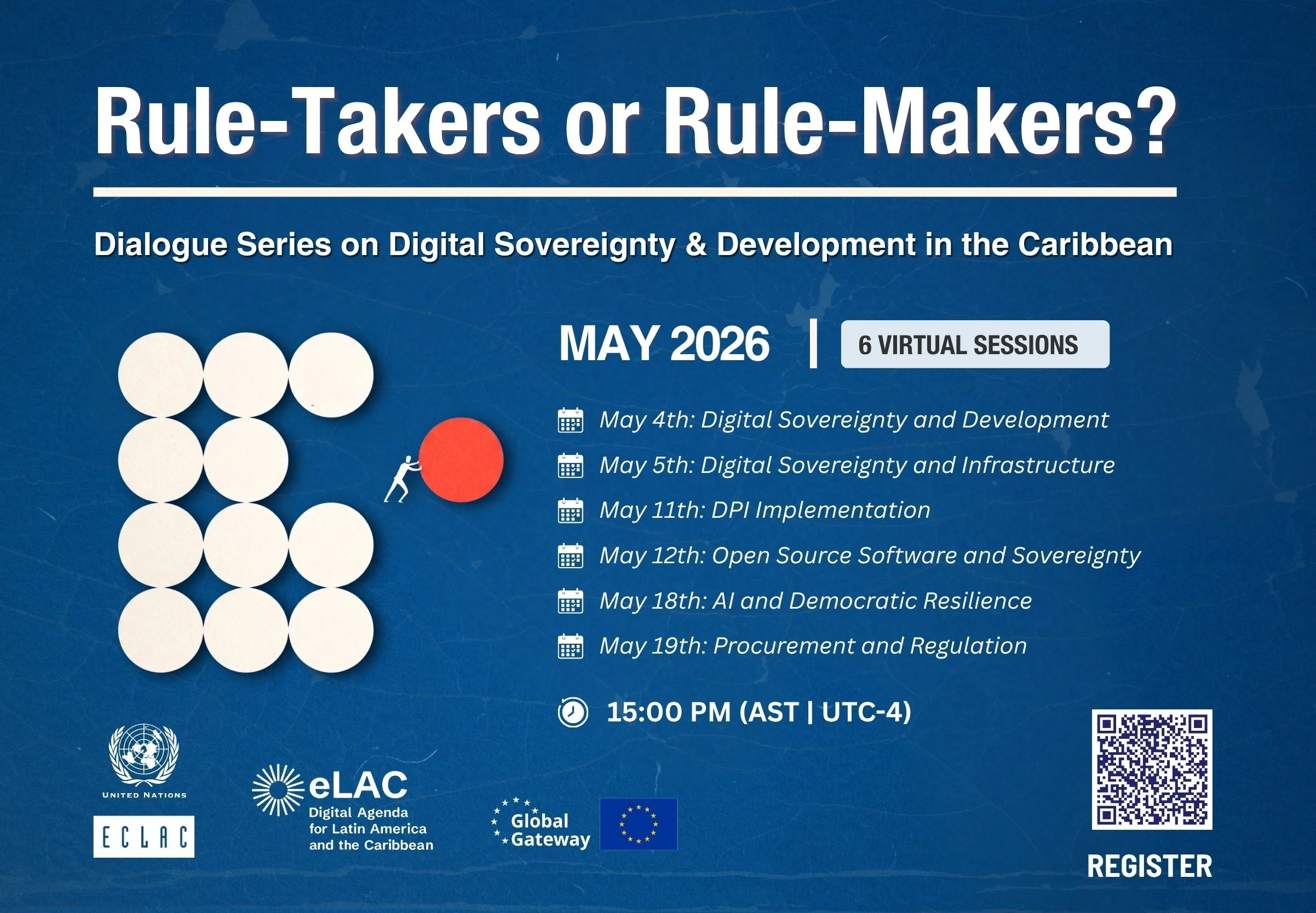
Speaking at UN ECLAC: the DPI approach and what it asks of the Caribbean
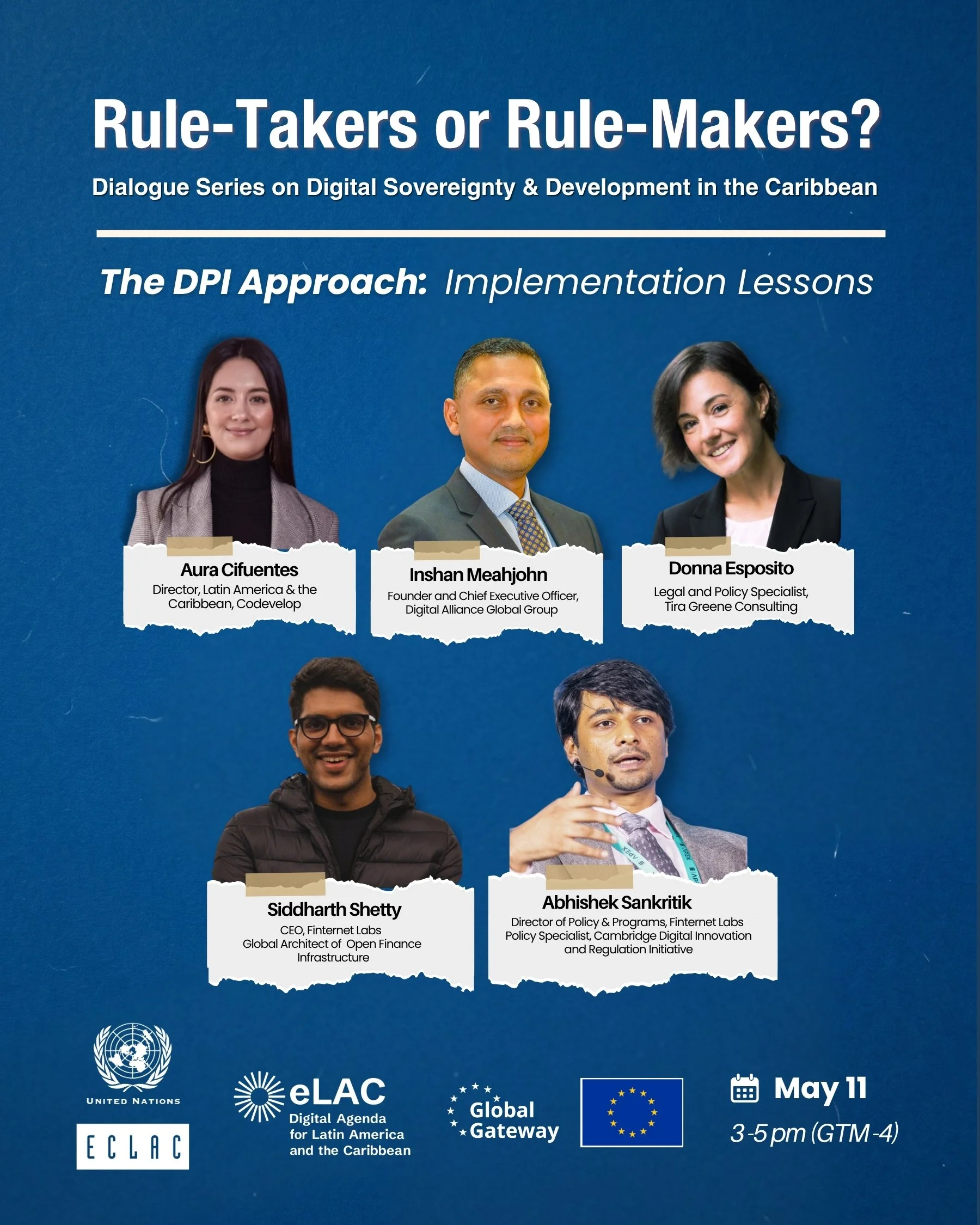
On Monday 11 May, I will join a UN ECLAC panel on Digital Public Infrastructure: Implementation Lessons. The session is part of “Rule-Takers or Rule-Makers?”, a six-part dialogue series on digital sovereignty and development in the Caribbean, convened with the eLAC Digital Agenda for Latin America and the Caribbean and the European Union’s Global Gateway.
This is also Digital Alliance Global Group’s first appearance on a multilateral platform. We chose this one deliberately. The series asks the question DAG was built to answer: how does a small state move from receiving digital architecture designed elsewhere to specifying, governing and partnering on its own.
The series title states the strategic question plainly. For most of the digital era, Caribbean states have written cheques against rules drafted in Brussels, Washington, Beijing, Geneva, and Mountain View. The standards arrived. The architecture arrived. The procurement contracts arrived. What rarely arrived was sovereignty over how those systems behaved once installed, who saw the data they generated, or who decided when and how they evolved.
DPI is the most practical correction available to small states right now.
The hourglass
DPI architecture rests on a simple idea. At the bottom of the hourglass sit the technologies and infrastructure governments and markets already use. At the top sit the public and private services citizens consume. The “thin waist” in the middle holds three foundational, interoperable functions: digital identity, payments, and consented data exchange. When the thin waist is built on open standards and operated under public-interest governance, the state can change suppliers, add services, or replace whole layers above and below without rebuilding from scratch. Sovereignty becomes a design property, not a press release.
Implementation is the hard part
The countries that have done DPI well, India with Aadhaar and UPI, Estonia with X-Road, Brazil with Pix, Singapore with Singpass, did not buy a product. They built a stack and wrote the law to make it stand up. Each story has a different shape, but the common pattern is unmistakable: identity first, then a payments rail, then data exchange, with statutory authority for each layer and an institutional home that survives an election cycle.
That is not the standard Caribbean digitisation playbook. Our default has been to procure modules from international vendors and bolt them onto legacy systems, often inside ministries that lack the in-house engineering capacity to govern what they have bought. The model produces dependence, recurring licence costs, and very little policy leverage.
The legal frame is the unfinished business
DPI without a legal frame is a security incident waiting to happen. Identity needs a primary law that defines lawful purposes and limits, with proportionate enforcement. Payments need rails operated under central bank oversight with clear settlement rules and consumer protection. Data exchange only works under a consent regime with teeth, audit trails, and a regulator that can act. In most Caribbean jurisdictions, at least one of those pillars is incomplete or missing entirely. That is a board-level risk for any government planning a DPI rollout, and it is the conversation regulators in CARICOM should be having now, not after the first incident.
Where partnerships actually help
Governments looking at DPI do not need another platform sale. They need partners willing to transfer capability, train sovereign engineering teams, write the standards into local procurement, and submit to local audit. That is the partnership model DAG operates on, and it is the model the rest of this conversation needs to normalise.
Panel and registration
Joining me on Monday: Aura Cifuentes, Director for Latin America and the Caribbean, Codevelop; Donna Esposito, Legal and Policy Specialist, Tira Greene Consulting; Siddharth Shetty, CEO, Finternet Labs and Global Architect of Open Finance Infrastructure; and Abhishek Sankritik, Director of Policy and Programs, Finternet Labs and Policy Specialist, Cambridge Digital Innovation and Regulation Initiative.
Monday 11 May, 3 to 5 pm AST (UTC-4). Open to the public, no cost.
I will publish my own notes from the session here on Insights afterwards.