

Why Serious Companies Are Creating Formal AI Leadership Roles
Many firms are adopting AI faster than they are assigning accountability for it.
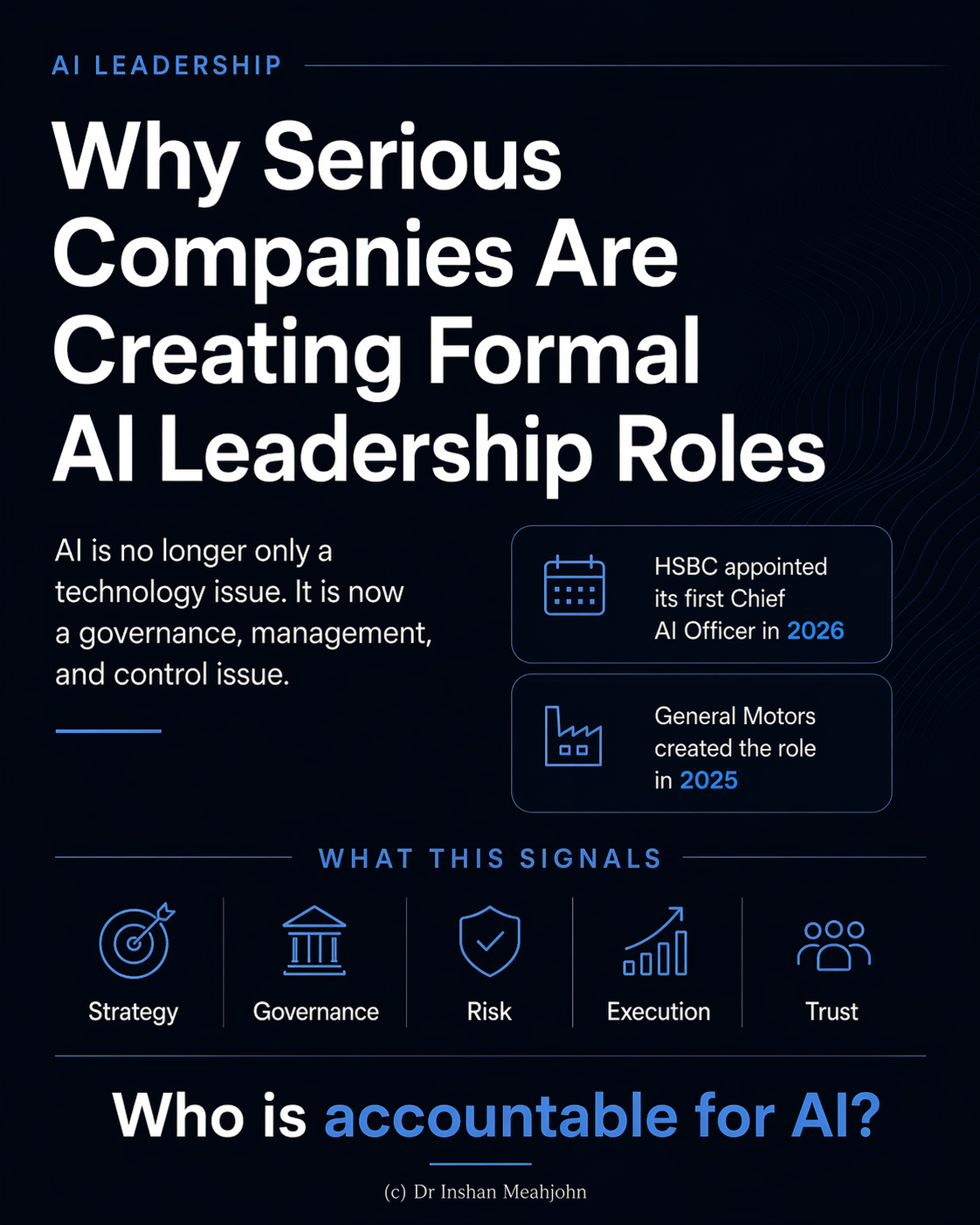
A structural shift is taking place inside serious organizations. They are beginning to formalize a new leadership role around AI. HSBC appointed its first Chief AI Officer this year. General Motors created the same role last year.
This is not a branding exercise. It is a response to a deeper management problem.
For many firms, AI is no longer confined to experimentation. It is increasingly being embedded into operations, decision support, customer interaction, software development, and enterprise workflows.
At that point, the question changes. The issue is no longer simply whether the organization is adopting AI. The issue is whether there is clear accountability for how AI is governed, controlled, scaled, and measured.
That distinction matters. Many organizations are advancing AI capability faster than they are establishing executive accountability for it. This is where the real risk begins.
Who owns AI strategy?
Who governs AI risk?
Who defines the guardrails?
Who determines where AI can act and where it must not?
Who is answerable when AI authority outruns institutional control?
In my view, the emergence of roles such as Chief AI Officer, Head of AI, or AI Governance Lead signals something important: AI is no longer only a technology issue. It is now a governance, management, and control issue.
But appointing the role is not enough. Without clear mandates, reporting lines, decision rights, and accountability, the title alone will achieve very little.
The organizations that will create the most value from AI will not be the ones with the loudest AI narrative. They will be the ones that build disciplined leadership around strategy, governance, risk, execution, and trust.
The important question for boards and CEOs is no longer whether AI matters. It is this: Who, in practical terms, is accountable for AI inside the enterprise?
Dr. Inshan Meahjohn is the founder of Digital Alliance Global Group, an international advisory practice on AI governance, cybersecurity, digital government, and human-centred leadership. Learn more at www.digitalallianceglobalgroup.com.
