

What 106 Trinidad and Tobago entrepreneurs taught us about thriving here. Notes from my keynote at Global Entrepreneurship Week 2026, UWI St. Augustine, 11 November 2026.
On Wednesday I asked a lecture theatre at UWI St. Augustine to do one thing before I showed a single statistic. Think of the person who taught you the most important thing you know how to do. Not a book. Not a course. A person who had already done it, sat with you, and showed you.
Most of the room had a name within seconds. That is the point. We ask young entrepreneurs in this country to take the risk, create the jobs and compete with the world, and we do offer support: programmes, workshops, sometimes a grant. The one thing everyone in the room had just thought of, that person, we mostly leave to chance.
The study
Between 2017 and 2019 I followed 106 entrepreneurs through the uSTART incubator at the University of Trinidad and Tobago. The same people, every year, three years running, and all 106 stayed to the end. I sat with 51 of them in focus groups and read twenty years of the international incubation literature, almost none of which came from a place like ours.
We measured four kinds of support: finance, business services, physical space and mentorship. We measured four outcomes: whether a venture was created, whether it created jobs, whether it grew, and whether the person became a more capable entrepreneur.
Mentorship was the strongest and most consistent predictor across all four. Finance was associated with two, job creation and growth. It was not a significant predictor of whether the founder became more capable.
That distinction matters. Capital provides resources. Mentorship builds capability. If we build ventures without building the people, we are funding activity, not foundations.
This is evidence from one incubator, observed rather than experimental, and I hold it with that care. It is also the first longitudinal evidence of its kind from a Caribbean small island state.
A room in 2018
In 2014, as Assistant Vice President for Entrepreneurship at UTT, I wrote the position paper that became uSTART: board approval, funding and a room. Into that room came two groups of students, one in animation and one in software engineering. After eleven months they became one company, Coded Arts, led by Andy Berahazar Jr. and Brian Perry. I was one of their mentors from the day they walked in.
What I remember is that they listened. They took hard advice without ego, acted on it, and came back ready to learn again. Before any cheque they had the room, the founders around them, and mentors, including Trinidadians in the industry abroad, who told them to take their strength in game art and sell it to international studios. Within a year they were at an industry seminar in Santiago, Chile.
In 2018 Coded Arts was about ten people in a borrowed room. Today, by the company’s own account, it is 35 people with team members in India, South Africa and the United States, earning foreign exchange and hiring creatives straight out of UTT, the same door they walked through.
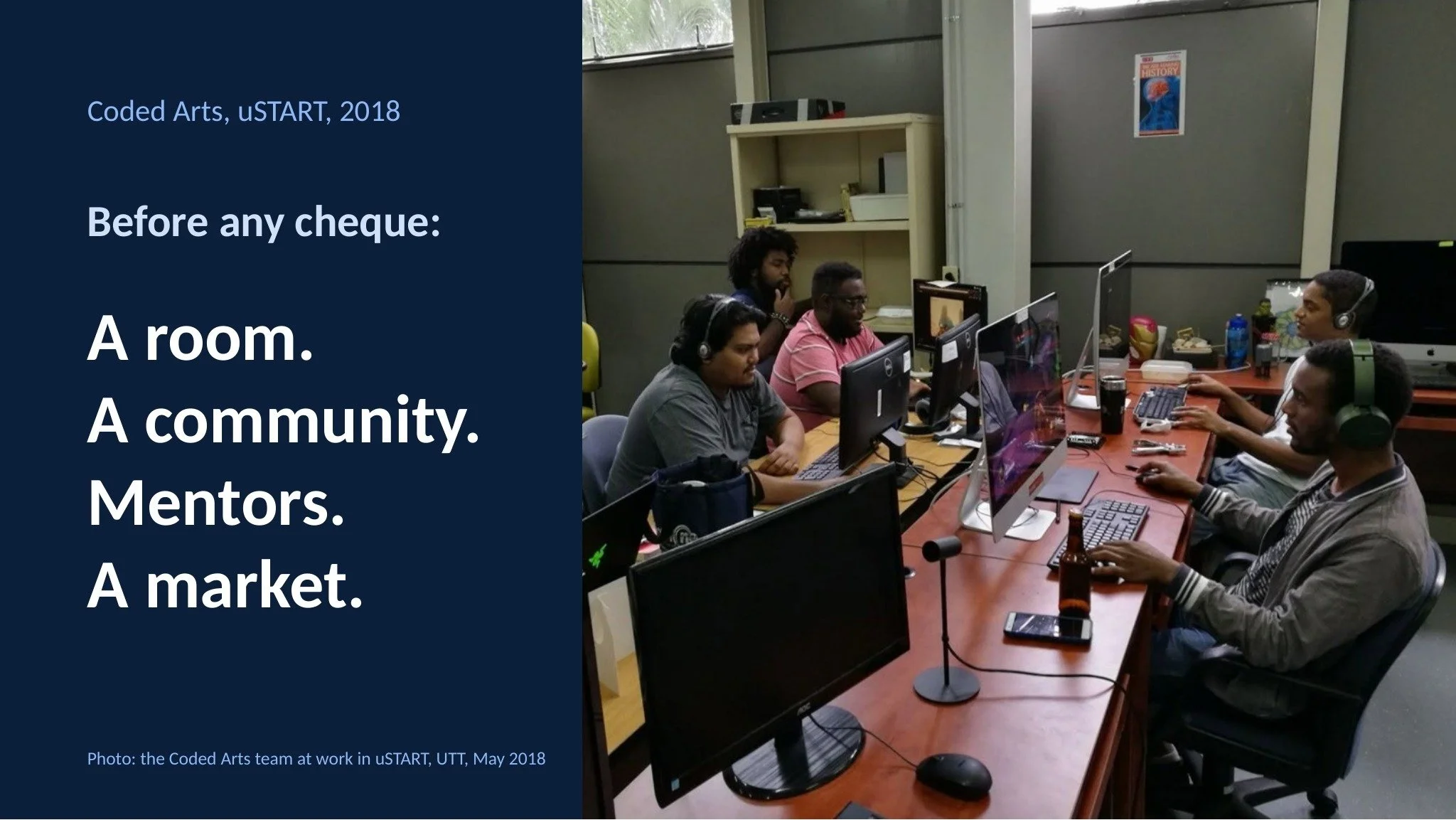
Slide from the keynote. The Coded Arts team at work in uSTART, UTT, May 2018.
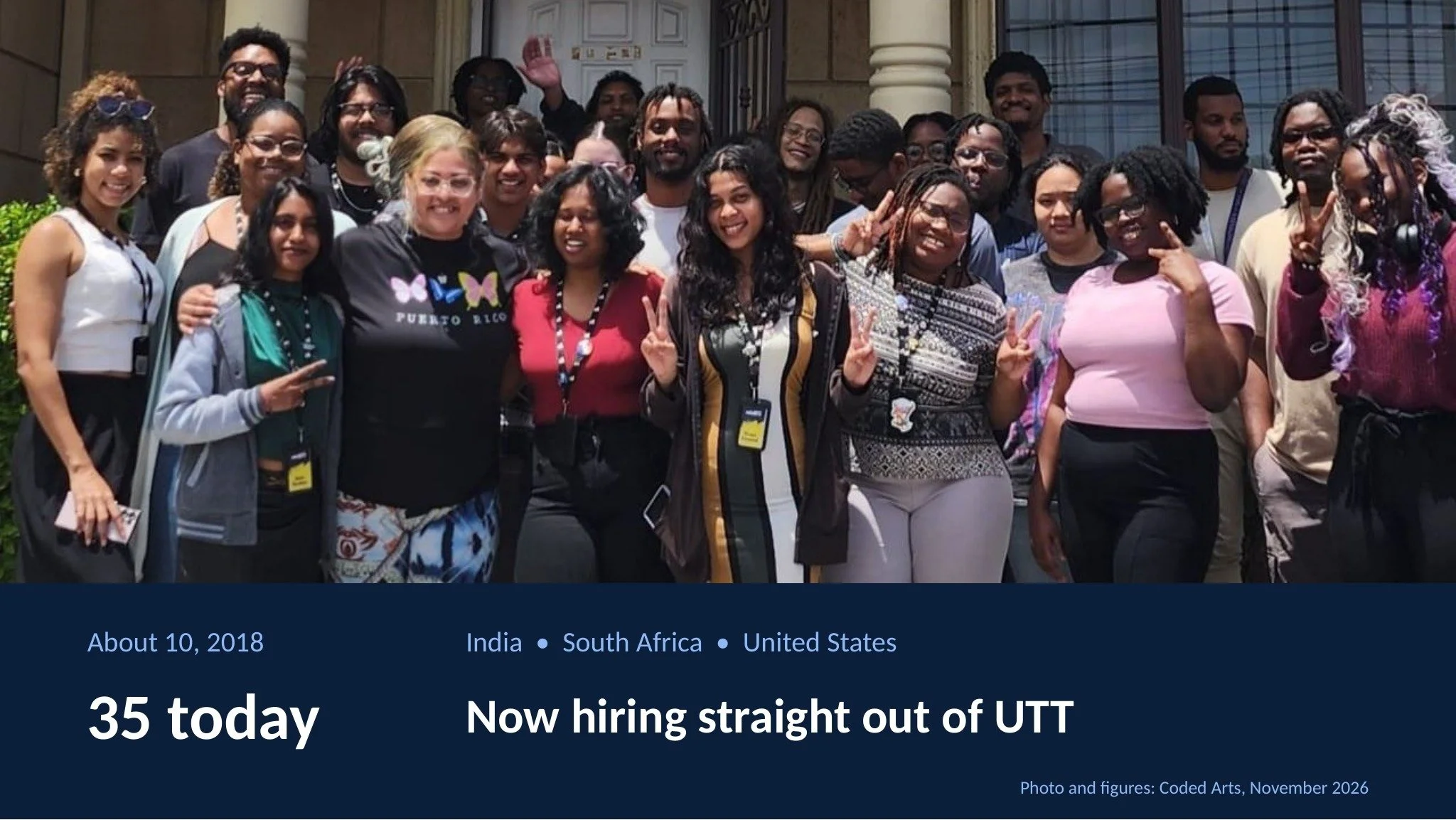
Slide from the keynote. The Coded Arts team, November 2026. Photo and figures: Coded Arts.
Capability first, then capital
The uncomfortable part came from the focus groups. Founders described what happened when a venture received seed money before the founder could plan and manage it. They spent it badly, scaled too early, and some ran out before they had a business that worked. Their recommendation, not mine, was capability first, fund second. Finance is still necessary. The evidence is about readiness and sequence.
One more number. When this cohort entered the programme, 15 per cent intended to export. Three years later, 46 per cent did. Intention, not yet sales, and the design cannot prove what caused it. It is consistent with one thing we did: the regional market was on the table from year one.
The question for universities
Universities measure what they teach: credits, completions, publications. Entrepreneurship asks a harder question. Are we measuring how much entrepreneurial activity we organise, or how much entrepreneurial capability we develop? The measure of a programme is not how many people enter it but what they become capable of because they were there.
So I left the room with three questions. To students: who is the one person who could help you turn your idea into something real? To lecturers: who are we connecting our students with beyond the classroom? To policy makers: are we investing only in businesses, or in the people who have to build them?
In a small island state, mentorship is not a luxury. Mentorship is infrastructure.
The research is published as Meahjohn, I. (2026), Journal of Entrepreneurship in Emerging Economies, https://doi.org/10.1108/JEEE-03-2026-0305. My thanks to Dr. Priscilla Bahaw and the Department of Entrepreneurship, Nutrition and Extension at UWI St. Augustine for the invitation.
